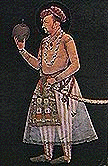
 Babur
Babur
The many elements that led to the creation of the Taj Mahal had their roots in the reigns of earlier monarchs : 1) Babur, 2) Humayun, 3) Akbar, 4) Jehangir, 5) Shah Jehan, 6) Aurangzeb, each of whom contributed his particular aesthetic interests and endeavours to the establishment of what we have subsequently called the Mughal Style, a style which blended the Persian patterns brought by the Mughals with the indigenous genius for fine craftsmanship.
The amazing achievements in the Mughal architectural tradition owe much to the great talent of Indian artisans and the wealth of material found in India, including the abundance of stone. Each emperor used local materials and indigenous forms and craftsmanship to nurture and bring to fruition a unique enduringly beautiful architectural tradition. The Mughal style found triumphant fulfilment in the building of the Taj Mahal, the most splendid expression of the centuries of Mughal rule in India. The Taj Mahal was the last and greatest architectural flowering of the Mughal period in Agra, before its builder, Shah Jehan (1592-1658) shifted the imperial centre of power and administration to what is now called Delhi.
Babur
Goto : Humayun,
Akbar,
Jehangir,
Shah Jehan,
Aurangzeb
 Home Page
 Humayun
Babur,
Akbar,
Jehangir,
Shah Jehan,
Aurangzeb
Home Page
 Akbar
Akbar
Nine years after he became emperor, Akbar, ordered the construction of a fort beside the river Yamuna in what is now called Agra. The construction proceeded at a hectic pace and within eight years, most of the five hundred buildings within the fort were complete.
By the time he was 26 years old, Akbar had power, prestige and great wealth, but despite a large number of wives, he had no heir. A mystic, by the name of Salim Chisti prophesised that the emperor would have not one but three sons. When the prophesy came true, Akbar decided to build a new capital city (Fatehpur Sikri) on the rocky ridge outside Agra upon which Salim Chisti had his hermitage, using the red sandstone of the ridge itself. Fatehpur Sikri consists of a number of highly individual structures united by the unvarying use of red sandstone and the intricate ornamentation that characterises them. Akbar employed local masons and craftsmen and allowed them the freedom to use their traditional skills to create a style which has been called Akbari.
At the summit of the ridge, Emperor Akbar built an enormous congregational mosque, the Jami Masjid. Later, he added a massive triumphal gate, called the Buland Darwaza at the southern entrance to the mosque. The dominant, aggressive dimensions of the Buland Darwaza provide a perfect foil to the other addition to the mosque; the single storeyed, daintily decorated tomb built for Salim Chisti.
Akbar's own palace was a double storeyed structure located behind a pool of water. Spectacular accompanying buildings include the Turkish Sultana Begum's palace, the Diwan-i-khas, the Panch Mahal, the Hawa Mahal, Mariam's palace and Birbal's house. The entire palace complex is adorned with exquisite carvings, lattice and pierced stone screens, wall paintings, canopied roofs, carved brackets and pilasters.
Akbar chose the site for his own tomb himself, at a place called Sikandra, near Agra. Sikandra, in a sense, marks the transition between the strong, square, earthbound buildings that characterise the Akbari style and the delicate airy marble structures that Shah Jehan built two generations later. The beginning of inlay work that was so much a part of Shah Jehan's buildings are visible at Sikandra in the bold patterns that decorate the gateway.
Babur,
Humayun,
Jehangir,
Shah Jehan,
Aurangzeb
Home Page
 Jehangir
Babur,
Humayun,
Akbar,
Shah Jehan,
Aurangzeb
Home Page
 Shah Jehan
With the accession of Shah Jehan to the throne, came a flowering of architecture both in Agra and Delhi. The profusion of white marble buildings raised during the period of Shah Jehan, led one scholar to characterise it as the reign of marble. Red sandstone and brick remained major building materials, but the use of marble is expressive of the very high standards of elegance and luxury that governed all aspects of an architectural project throughout Shah Jehan's reign. The innovations seen in the buildings created during Shah Jehan's reign are striking demonstrations of the effect of particular aesthetic and political concerns. In addition to a greater use of marble, which was a textural quality quite distinct from the red sandstone favoured by his predecessors, there was refinement of the architectural vocabulary. Among specific changes were the introduction of cusped arches and of pillars with tapering shafts and baluster detailing. Many developments can be directly related to a desire to articulate more forcefully paradisiacal and imperial theme, drawing on sources that included European motifs.
Shah Jehan had many earlier structures in the Agra Fort dismantled in order to make room for his own marble pavilions. It seems that immediately upon his accession in 1628, Shah Jehan ordered palace additions to the existing forts at Agra and Lahore. The most notable complex of white marble palace structures is situated on the eastern edge of the fortified walls built by Akbar bordering the Yamuna river. Among these is Muthamman Burg (Jasmine Tower), built at a point where the main north-south wall of the fort takes a turn towards the east. The octagonal room, which offers an exceptional view of the Taj Mahal, is supposed to be the place where Shah Jehan died in 1666. The Muthamman Burg is connected with a series of other marble pavilions forming the east side of a large courtyard that once contained a garden. Only the structure and not the flora survives today. To the north of the palace quarters bordering the garden are additional rooms including the Hall of Private Audience, which is a marble pillared hall decorated with profuse inlay. The Shish mahal which is located close to the royal apartments, has hundreds of small mirrors embedded in stucco decorations, in intricate floral and geometrical designs. Some distance away is the magnificent Moti Masjid, the Pearl Mosque built at an elevation so that its ethereal domes and kiosks are visible above the walls of the fort.
Babur,
Humayun,
Akbar,
Jehangir,
Aurangzeb
Home Page
 Aurangzeb
Although patronage declined after the reign of Shah Jehan, elaborate architectural projects were undertaken for later Mughal rulers. The Badshahi Mosque in Lahore and the Pearl Mosque in the Delhi fort are but two examples built for Aurangzeb. Aurangzeb chose to be buried in a simple open-air grave, but the tomb of his wife (Bibi-ka-Maqbara) at Aurangabad, is quite elaborate. Although small, the Pearl Mosque in particular, represents a continuation not only of the architectural vocabulary established during the reign of Shah Jehan but also of the use of expensive building materials such as white marble, though the elongated shape of domes and arches signals a change in taste.
Soon after Aurangzeb's death the empire broke up. The 19th. and last Mughal ruler, Bahadur Shah II was deposed by the British in 1858.
Babur,
Humayun,
Akbar,
Jehangir,
Shah Jehan
Home Page