PIETRA DURA INLAY
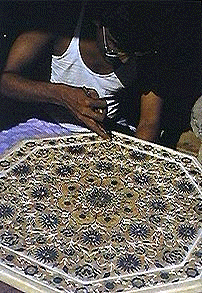 The technique known as pietra dura, whereby thin sections of precisely carved hard and semi-hard gemstones are laid in sockets specially prepared in the surface of marble, is another mode of ornamentation prominently featured on the Taj Mahal. Here, the pietra dura inlay is wrought into the form of arabesque floral tendrils which meander over the surface of the white marble in a lyrical and graceful pattern that transcends its inherently restrictive symmetry.
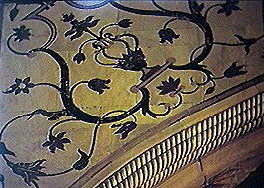
The use of pietra dura in India has become a matter of great controversy for years. Some have claimed that it was derived from Florentine traditions, others that it developed independently in India. Recently, it has been cogently argued that the technique was indeed Italian in origin, but that it was modified by Indian traditions of craftsmanship. The argument hinges on the recognition of the difference between two related types of inlay. Although conventional stone inlay had been known in India for a long time (stages of indigenous development from the Ranpur temple to the tomb of Akbar are perfectly clear), the practice of pietra dura, which involves inlaying stones of extreme hardness, has in every instance of its development been traced back to an Italian source, and it is quite likely that European craftsmen taught it to the Mughal artists. There is no doubt that the Mughal sovereigns freely entertained artists from Europe.
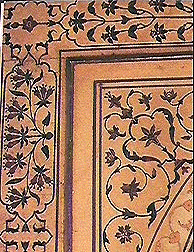
Both stone inlay and hardstone inlay are found in the tomb of Itimad-ud-daula and his wife at Agra, built between 1622 and 1628. But it was in the earliest projects of Shah Jehan's reign that the pietra dura work was fully perfected and then adopted as an important means of decoration - perhaps the ideal one to be employed at the court of an emperor who would appreciate both the high level of skill entailed by the process and the jewel-like qualities realised in its finest products.
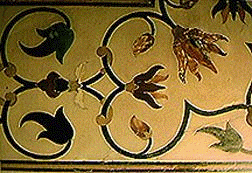
flowers
Flowers have long been important in Islamic cultures, where they were generally seen as symbols of the divine realm. The Mughals had maintained a special interest in flowers since the days of Babur, who was an avid garden-builder. Shah Jehan's father Jehangir had been quite fascinated with nature, and his passion for flowers is well documented by his memoirs. Shah Jehan seems to have shared this interest. Jehangir seems to have been the catalyst in the introduction of naturalistic plants into Mughal paintings, which were inspired by engravings in European herbal books that had been brought into India by foreign visitors. But it was in the time of Shah Jehan that Indian artists refined such depictions, transforming them into the hallmark of the Mughal decorative style. The Taj Mahal reveals that the importance of floral motifs in an architectural context was established early in the emperor's reign.
 Home Page
 Actual Tomb